How to Deal with Negative Thoughts?


One of the questions that is frequently asked during my training and coaching programs, is this…

ā€œHow do I deal with negative thoughts?ā€
Before addressing this question, we need to understand, ā€œWhat do we mean, when we say negative thoughts?ā€
Negative thoughts are thoughts that create uncomfortable emotions like Fear, Anxiety, Worry, Guilt, Jealousy, and the myriad of other combinations of these emotions… Fear could be triggering worry and jealousy could be triggering guilt and so on and so forth.
We also need to understand some basic things about the brain and mind.
I feel Human Brain is one of the most complex creations in the entire universe!!!
It is mainly programmed for two things.
One is for learning…
The other is looking out for danger…
When you need to cross a busy road with high traffic, your brain wakes up to the possibilities of any danger… And that is a useful thing… right… Being completely positive, without taking into consideration the risks, could be dangerous… right?
Yes, these so-called negative thoughts do serve us, at a very important level…
But at times, we can feel that this ā€œlooking for dangerā€ is getting too much frequent, loud and sometimes out of control… And this could create problems for us. We need to have reasonable control over the negative thoughts and for that we need to understand them.
We need to understand, that the more we fight these, the stronger they become… The more we try to resist them we give them power. So, one thing we can do is, ignore them. How do we do that…. By, being ok with them and at some level accepting them as a part of living… I came to know about a formula, which can help us… The formula is called as RAVIJ formula, which is an acronym in this context.
Do not RAVIJ, is the message here: Do not RAVIJ the negative thoughts…
Do not
R – Resist the negative thoughts
A – Analyze the negative thoughts
V – Visualize the negative thoughts
I – Identify with the negative thoughts
J – Judge the negative thoughts
Just like the clouds passing in the sky, let those thoughts come and let them go… Let us choose to focus on the Sky beyond…
Ok… Using RAVIJ , I can deal with negative thoughts, then what you may ask… Yes, you have got it right… we need to go to the next level… We have cleared some space now… we need to fill it up…. with what, you may ask?
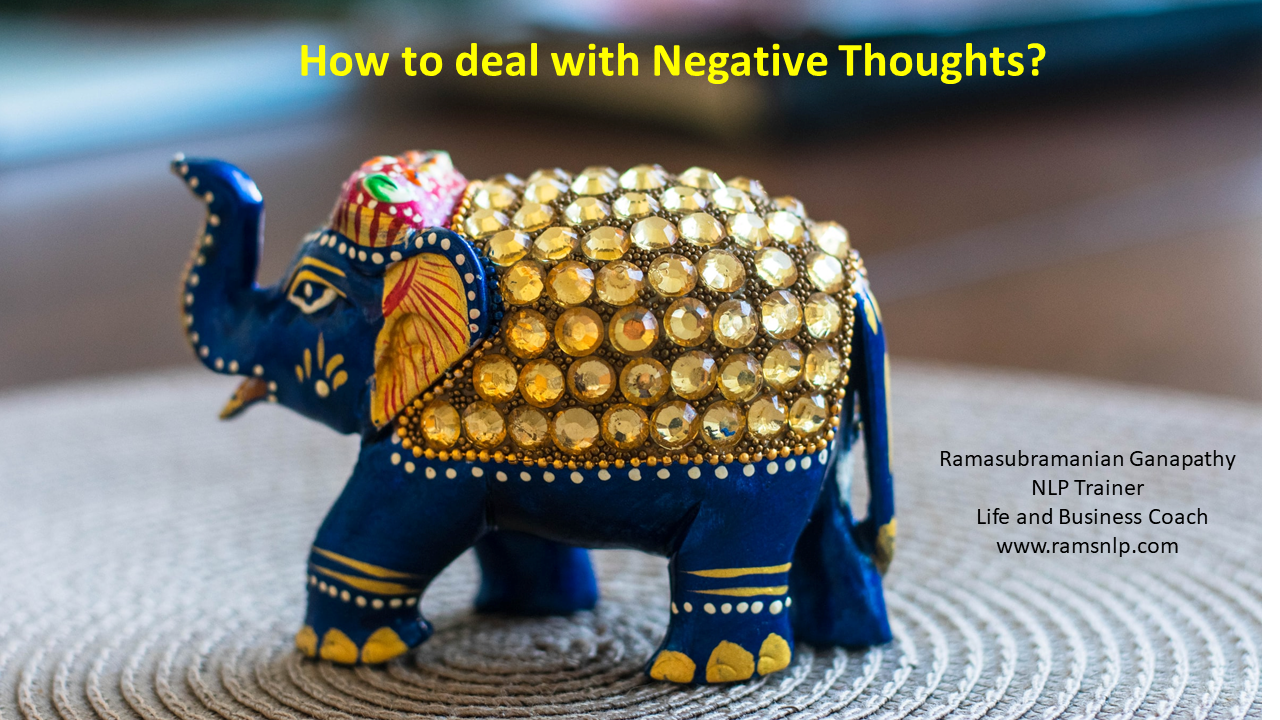
Imagine an elephant with his Mahout, walking on a street, with small shops on both sides… The elephant, being curious, stretches its trunk and grabs hold of anything and everything hanging in front of the shops nearby… the shop owners shout out, asking the mahout to do something about it…
The Mahout has a bamboo stick with him. He removes an object which the elephant has picked up from the latest shop and instead gives the bamboo stick to the elephant…
Now the elephant has something to engage with and holds to the bamboo stick, steadfastly and forgets about all the objects hanging in front of the shops…
Similarly, if we can hold on to something that is positive, in the sky space that we have chosen to focus, we can Identify our deep driving goals, and just like the elephant, we can choose to focus and hold onto them, leaving lesser space for those negative thoughts to float by…
And you could ask me, what this Elephant represent? Being mighty and strong, it would represent the Mind I say…
And before you ask another question, I ask myself, what would that Mahout represent… and I answer to myself, ā€œthat would be the Awareness ā€œā€¦

Ramasubramanian Ganapathy
NLP Trainer
Life and Business Coach
www.ramsnlp.com

Mad Dog or Pot of Gold?

NLP ( Neuro-linguistic Programming ) talks about two important elements in goal setting. One is the Moving towards and the other is the Moving away.

Imagine a 100-meter running race. Let us say an average person can run the 100 meters in say, 25 seconds ( it is just a guess friends ). What can be done to motivate him to run faster…? One way is to keep a pot of gold at the winning line. Now he can run faster, may be cover the distance in 20 seconds.

the second way would be, to make a mad dog ( a drooling mad dog ) chase him… He would run really fast, and may be cover the distance in, say, 15 seconds.
This pot of gold and the mad dog are metaphors for two designing principles in our life. One is the Pleasure principle ( the pot of Gold ) and the other is the Pain principle ( the mad dog ).
There is great value in both these elements. while we work hard and put in effort to get what we don’t want, we also spend more energy and effort in avoiding things that we don’t want. Both are parts of living and life.
But there is an important distinction that we need to make note of. While running towards a pot of gold can help us get that, running away from a mad dog can make us run anywhere, and in the process, we may end up with a Tiger.While the mad dog gives us motivation the pot of gold gives us direction. And the right balance between the mad dog and the pot of gold can make us really effective.
This healthy balance between the moving towards ( pot of gold ) and the moving away ( mad dog ) helps us stay committed to the project and at the same time be unmindful of the any pain associated with the process.

We don’t mind standing in the queue for a long time, for getting the ticket to a cricket match in which our favorite team is playing or for the first day first show experience of favorite hero’s movie.
When we move towards something, the decision making also becomes easy. Because if you don’t know, where to go, which bus will you board?
So one question that we can choose to ask ourselves is : while I want to move away from certain things in my life, am I clear about what is that I really want…
If we don’t know what we want, we might get stuck with what we don’t want…

For learning more about NLP

click the ā€œ Learn More ā€œ link…
https://nlptrainerram-22e93.gr8.com/

Gratitude Timeline Process

Being grateful can be a powerful way to deal with stress. When stressed we may not be aware of all the great things that happened and continued to happen in our lives. Being consciously grateful, shifts our focus to the very many positive things that had happened / happening in our lives.

It also helps us to neutralize the ā€œ Why Me ? ā€œ question, that we may ask sometimes in our lives.

The first and last few minutes of our day, if filled with gratitude can make a big difference in our feelings for the day.

I was trying with various processes for being grateful and gradually felt a process which is working for me… I would like to share it with you…

Sit comfortably, close your eyes and put yourself in a relaxed state. Visualize your timeline and get associated with the time of your birth. You need not get specific here… Just start with whatever it means to you with a level of comfort.

Gently move forward in the timeline and as you do that, become aware of all the people you can be grateful for. If you are a believer in God, you can start with your version of God, for giving you this opportunity of Life and living. (If not you can start with your parents.)

You can include your parents and other family members who provided for you and protected you. As you move forward in your timeline allow your unconscious to unfold and reveal other people like your teachers, relatives, friends and other well wishers who have given you great gifts. As you move through your timeline through various stages in your life, feel grateful for all the people, places, occurrences, events and even objects that have a pleasurable meaning for you.

Come to your present moment in your life and if you are a believer, pray for continued Protection, Provision and Progress with a Purpose in Life. If not you can look forward to many more such grateful moments in your life. End the process with the feeling of gratitude saturating you.

Let this process naturally unfold every day and be spontaneous. You can have a few of these grateful points regular, like your version of God, parents, teachers, friends and let other grateful points unfold spontaneously, bringing in more variety every day.

Do ensure that the process does not become a disconnected ritual. If you can associate strongly with the  grateful moments, that could make the process very effective.If you can find a balance between regular and a variety of grateful moments, that can also help. Be aware of the time it takes, and tune the process to an optimum level of time. For me it takes about less than 5 minutes max. Use the empowered states you get out of this process, for reaching your intended outcomes in life.

You can choose to do it twice a day ,once as early as possible and once before you go to bed.

Let this process evolve over time, to get your unique process of being grateful with a timeline. This process is evolving for me and I would fondly like to call it ā€œ Gratitude Timeline Process ā€œ.

Do try it out and check it’s utility value for yourself…

Best wishes…

Ramasubramanian Ganapathy

NLP Trainer and Coach

NLP Course and Human Brain Trainings

How Can We Train Our Own Mind Through NLP Course

NLP Course and Human Brain Trainings

One of the biggest challenges for a man is to train and control the mind, which can be breakable by NLP Course. The mind is a powerful force that can make or break a person.

There has so many principles, practices, and techniques for training the mind.

Ranging from philosophical and religious to personal development and growth, the fields and objectives of mind training vary.

NLP or Neuro-Linguistic Programming as it is famously called is a powerful tool and is known for mind training.

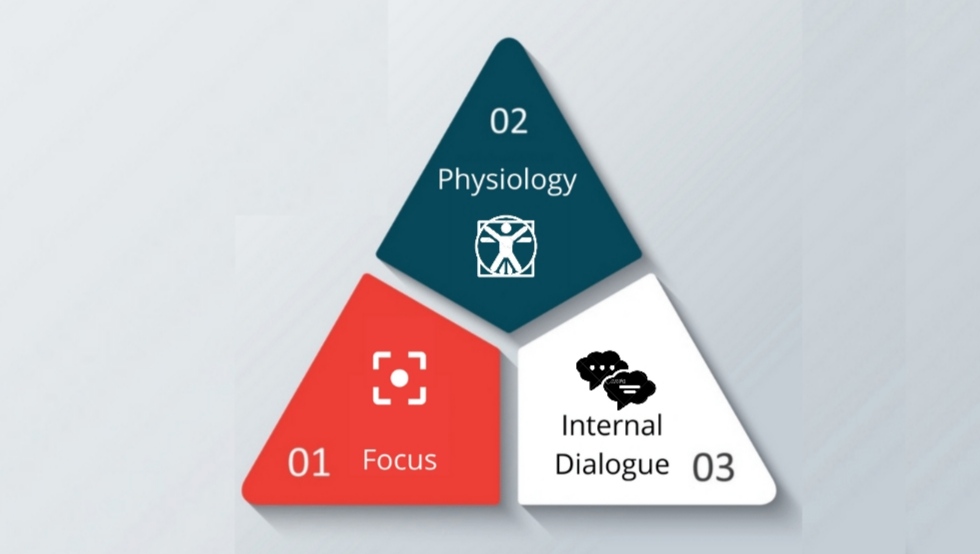
NLP considers the Mind as a Metaphor for the functioning of the brain. As per NLP the Mind state or emotion is the result of the three elements.

  • Physiology ( How a person arranges his body )
  • Focus (Where the attention of the person goes )
  • Internal dialogue ( the words the person speaks within himself or herself )

The following diagram can help in understanding this.

NLP Process

the above diagram is used in NLP course to illustrate the concept of emotions or Mind states. this diagram can give us deep insights about training the mind using NLP.

The top corner of the triangle is the Physiology. Physiology is how the person holds his body. Elements like standing straight or slouching, open or closed-chest, whether the facing is looking forward or up or down, the breathing is shallow ( just at the top of the lungs ) or deep ( belly breathing ) constitute the physiology of the person.

The bottom left point is the focus. Where the person is paying attention to. It could be in the past, or in the future, and in the here and now. These different states like the past, present, and future have big scope in the training of the mind using NLP. So far now, we need to understand that focus is the attention given to any incident, people, place, or object that has been experienced in the past, or being experienced in the present or imagined in the future.

The bottom right point is the Internal dialogue. It is nothing but the ā€œ Thinking ā€œ a man does. Thinking is the nature of mind and actually training the mind could mean training the thinking process.

Thinking is about language. We think by using language. ( of course, it is said that few people can think visually, but most of us are thinking using language. it is a conversation which we have with ourselves.

This element is very powerfully used in NLP for mind training. Our words define our experience. The word and experience are strongly associated. You can try this for yourself. Think of an experience and identify the word that you normally use for describing that.

Now consciously choose and use another word that is similar to the word that you normally use. For example, if you were using the word ā€œ great ā€œ to describe a vacation ( It was a great vacation ), try changing that word great into ā€œ nice ā€œ. ( It was a nice vacation ) . You can feel the shift in the emotion as you replace one word for another. When you use the word ā€œ Spectacular ā€œ ( It was a Spectacular vacation ), you can feel that the excitement increasing many times.

So these three elements ( Physiology, Focus, Words as in internal dialogue )are the corner points of the emotional triangle. So, it can be inferred that if we change any one corner of the triangle the shape of the triangle changes which means that the emotion changes.

This understanding that if we can shift or change not necessarily all three, but even one element, can change our emotion, is a very important tool for training the mind using NLP course.

Let us take an example of a failed businessman, to fit in this emotional triangle.. His last ventures have failed. Let us imagine him sitting in a chair and brooding deeply.

Let us observe his physiology. Body slumped, Shoulders collapsed, breathing shallow and eyes looking down, would display the classic disappointed or depressed mental state.

Now let us think about his focus. Where is his attention on? It is on the past, on the last three ventures which failed. he is continuously thinking about them, although he knows that the more he thinks about them, the more saddened he becomes. However, he is not able to divert his attention. His mind seems to be engaging in those failures in a very powerful way.

Now let us investigate what is he thinking in his mind.

Here we need to understand that thinking is nothing but the use of language to oneself. If you can observe it deeply you can observe that it is in the form of a question and answer. This businessman, maybe keeps saying to himself ā€œ that was a bad choice, I should not have done that ā€œ again and again. The words like a bad choice, shouldn’t have done, keep on replaying again and again and hence cause a particular emotion or a mental state in alignment with the other two elements of physiology and focus.

Now, how can he change this emotion? For if he continues to be in this same mental state, he may slip into a deeper depression, and it wouldn’t be useful to him.

So how can he shift his mental state and start feeling better?

One may be he can stand up, stretch, open his arms wide and look above, maybe for some seconds. This new physiology is not conducive to negative emotion. You can try this for yourself. Stand up stretch your body, open your chest, spread your arms and look above. After doing this, try feeling sad in this same position. You would find that it is difficult to feel sad, because this position, communicates a feeling of happiness to your brain. ( have you seen the laughing buddha statue, with the same physiology?

This is one way to train the mind using our NLP Course, by using physiology change.

The second thing he can do is, shift his focus to another memory, in which he was able to meet a challenge head-on and solved it successfully. Simply remembering a past success. he can himself in that experience as though it is happening now, for a few moments and feel how good it was, at that time, and choose to experience that good feeling right now.

This is another way where one can train the mind using the NLP course.

The third thing that he can do is, choose a positive affirmation and start repeating it to himself with positive emotion and optimism. ā€œ I have solved similar problems earlier, and I can do so now ā€œ. ā€œ I am a learner and I can quickly learn to solve this situation ā€œ

A simple but powerful affirmation by Emily Coe is ā€œ Every day in every way I am becoming better and better ā€œ is used by millions of people the world over. Although it looks simple, the principle is powerful. The words that we use, define our experience.

This is the third way, to train the mind using NLP.

So dear reader, I would encourage you to use these principles in training your mind, using the NLP course, for personal and professional development.

How an NLP course Reframing Phase train your mind

NLP Course Reframing Brain

In this blog, we will see how the second element of an NLP Course (Reframing Phase) can help you train your mind. We have been talking about the ARM of NLP, where
A – Anchoring
R- Reframing
M – Modelling
are the three fundamental aspects of NLP. All the techniques of NLP form a part of either of these three. In our last blog, we saw how Anchoring can help you train your mind. Anchoring as a part of the course in NLP can help you train your mind using NLP.
Now let us see how the NLP Course Reframing phrase can help you train your mind.

NLP Course Reframing – Definition:

Reframing is an interesting but very powerful concept in NLP. It is not that, Reframing evolved through NLP. Reframing has been a part and parcel of people, the world over.

All the religions and wisdom practices actually propagate reframing in various ways. An NLP course that teaches reframing can help you train your mind.
What NLP has done is to structure it in an effective way, so that it can be made teachable and learnable. What people have been doing as reframing, unconsciously can now be done more consciously and could be learned, to be done more effectively.
We already saw that the philosophy of NLP is this:

  • Neuro – Experience (derived through the 5 senses)
  • Linguistic – Meaning ( given by using language)
  • Programming – Behavior ( that emanates from the meaning).

For more details about this, you can meet me at one-to-one NLP Coaching.

The experience we have with this world (Territory as NLP would call it) could be a positive or negative one. If it is positive we would enjoy it. If it is negative we would strive to change it. If it is possible to change it, it is OK and we feel good.

But what if, we are not able to change the negative experience. We fight harder and in the process, we suffer more. Suffering is defined as an argument with reality. The more we fight the more we suffer.

Based on what we saw before, it is the meaning of the experience that creates positivity or negativity to it. It is said that pain could not be avoided but suffering is optional. Suffering is at the level of the mind and is dependent on the meaning we attribute to the experience.

So if the experience is difficult to change, NLP would suggest we, stop fighting with the experience and treat it as neutral. Then with our creative faculty, it would ask us to create a better meaning for the same experience.

A micro-managing boss could be extremely frustrating. But while still working under him, if a subordinate gets frustrated, because of that frustration he might make more mistakes, which would, in turn, prove that the boss was right – he has to micromanage.

The idea here is, to enter a state of mind, that can help the employee perform his job well so that the micromanaging boss can micromanaging is no more necessary.

A better meaning comes up with better behavior, which in-turn indirectly gives a better experience.
This is the principle of Reframing. This is a great way by which an NLP course reframing part helps you train your mind.

When a father complains that his teenage daughter is not listening to him, the experience can be reframed as, the daughter is trying to explore life for herself, and want to stand on her own legs. This could mean that the father has more time for himself, which he can use to invest in his own ventures, while he can still have a watchful eye over his daughter and be available when she needs him.

The employee, who just lost his job, could reframe the experience as an opportunity for trying out his entrepreneurial venture.
When a student gets low marks in an exam, he need not frame it as a failure. Instead, he can reframe it as feedback, and come out with better strategies for studying and getting more marks.

You can remember something which is often being said in Motivational seminars. The only thing really out there is ā€œSituation ā€œ.
You can choose to look at it as a Problem, or a Challenge, or an Opportunity. You have the choice and the choice is yours. This is classic Reframing. This is a great way, where NLP can be used to train your mind so that you can choose your responses to your experiences.

I feel that the main purpose of Religion and other Wisdom Practices is to help us give a better meaning to this phenomenon called Life. This is a big chunk reframing.

I will leave you with a question. What is your frame of Life? What is the meaning you give to this Life? If it is working for you and is useful quite ok. If not are you willing to reframe? Hope the NLP Course reframing part has helped you understand the strength of your brain

How an NLP course Anchoring Phase train your mind

NLP Course Anchoring Brain

NLP is considered a powerful tool for personal and professional excellence. This happens because an NLP course helps you train yourMind. NLP courses work at multiple levels to bring powerful transformation. Like behavior, capabilities, values, and beliefs and also at the level of Identify an NLP course can create positive changes.

And all these changes start with the Mind. NLP Courses work by training the mind. For deep thinkers, it can be felt that the world is not outside there. But it is inside our heads. An NLP principle says ā€œ Perception is Projection ā€œ. It could also mean ā€œ what the mind cannot see, the eye cannot seeā€. We tend to see what we want to see. Other things which are not in alignment with our existing beliefs and values, may not be clearly perceived by us.

This concept is called the Psychological filter ā€œDeletionā€œ. Lots of data from the external world called ā€œ Territory ā€œ in NLP terms, stream to us. It is said that about 7 lakhs bits of data / second stream to us. Our brain cannot process all this data. Hence we have 3 psychological filters called Generalization, Deletion, and Distortion. You can get more details about these in the video here :

So, as seen earlier, an NLP course helps you to train your mind. Training your mind to get what you want. Let us break out this in three elemental ways, by which an NLP course can help you train your mind.

These three elements are called ARM of NLP. They are

A – Anchoring

R – Reframing

M- Modelling

Let us see these three elements briefly

Anchoring :

An anchor is an external stimulus that produces consistent mind states. For example, an old black and white photogram of you and your friend can immediately put you in a happy state.

The award that you got, for being the most productive employee,  that you have kept in the showcase, can be a powerful anchor, which immediately makes you feel proud and build your self-esteem.

The Anchor can be a picture, sound, a touch, a smell, and also a taste.

Now the issue is not all anchors are positive in nature, in the sense, they create not positive emotions, but create negative mind states. For example, the name of a particular city, where something untoward happening to you, can remain etched in your memory, and whenever you hear or read the name of the place, you actually start feeling bad.

A person, who happens to receive very bad news, while eating ice cream, can start feeling bad wherever he sees an ice cream.

So, we can understand that Anchors can be all around us, putting us either in positive or negative mindstates. These Anchors happen mostly unconsciously, and we may not be having control over their formation or occurrence.

An NLP course can help you create consciously very powerful Positive Anchors, which you can use at your will to change your mind states from something negative or neutral to something very positively powerful.

An NLP Practitioner is required to create a few anchors for himself/herself for shifting mindstates to positive ones and also help other people create one.

Let us briefly talk about one Anchor, that I normally teach in my NLP Course, ā€œ The Golden Circle of Excellence ā€œ

The purpose of this Anchor is to utilize a positive memory from your past, Identify the Resource or the Positive emotion you had at that time, and then access that resource whenever and wherever you want.

So, the requirements are,

1 – A strong positive memory you have that is very fresh and easy to access.

2- Identifying what is the resource or emotion you had at that particular time. For example, the memory where you got the best employee award could be a resource of pride, confidence, or self-esteem. You need to choose one resource with one name for maximum effectiveness. Later you can add many resources to the same anchor or other anchors.

3 – Identify a future situation, where you want to use this resource, easily and effortlessly with maximum effectiveness.

If you have done so, then here is the Procedure.

Golden Circle of Excellence Procedure                                        

  • Choose a resource that is needed to handle a current challenge
  • Choose a past memory in which the required resource was in abundance
  • Put yourself in a mild trance, while being able to maintain a comfortable standing position
  • Visualize a golden circle on the floor about one to two feet in diameter
  • Step into the circle and access the memory
  • Relive the memory in its entirety in VAK ( What you See ( Visual ), What you Hear ( Auditory ) and what you Feel ( Kinesthetic )
  • Focus on the feeling and intensify it
  • At the peak, leave the emotion inside the circle ( like a pillow cover, being drawn and dropped from a pillow ) and step back
  • Break state by observing or counting things in the room
  • Repeat the process once more
  • Break state by observing or counting things in the room
  • The third round is the test round
  • After putting yourself in a mild trance state, visualize the golden circle on the floor and step directly into the circle
  • Allow the VAK to be accessed
  • If the earlier steps had been done effectively, the test round would bring in the required resource automatically, at least to some extent
  • As you are accessing the resource future pace and see yourself using the resource in an appropriate situation effectively
  • Give permission to your unconscious mind to access the resource at appropriate times.
  • If the test round is not effective, the trance depth may not have been adequate, or the person may not be fully involved
  • Repeat the activity for few weeks until the anchor becomes set and can be fired inappropriate situations

So, do try this out and check it for yourself. You can also join My NLP Course, and learn it directly from me. You can access my courses on my website.

You can learn the other two elements Reframing and Modelling from my upcoming blogs. Remember NLP courses can help you train your mind, for the better.

NLP Training

5 Best ways how an NLP Ā Training can help you

NLP Training is the buzzword in personal development circles now. If you are interested in Personal development there is every chance you might have heard about it. And you also wondered about it.

Fast and Miraculous transformations are attributed to NLP Training. You might be thinking about how NLP Training could do this. If that is the case, then this blog can help you understand the NLP phenomena better.

NLP Training

NLP stands for Neuro-Linguistic Programming. Each word is specifically significant and represents particular domains.

The word Neuro represents our central nervous system that is made of our brain, spinal cord and associated nerve systems. We process the data from the world around us as ā€œ Experiences ā€œ.

And we use language to interpret these experiences to give ā€œ Meaning ā€œ to these experiences – the linguistic part.

And we engage in a series of behaviors based on the Meaning which we give to these experiences. This is the programming part.

Neuro – Experience

Linguistic – Meaning

Programming – Behavior

Very predominantly the behavior depends on the meaning which we give to the experience and not to the experience itself. So if one wants to change the behavior he need not change the experience itself. All he has to do is change the Meaning of the experience and a better behavior will emerge.

The better behavior will indirectly bring him a better experience.

This I believe is the basic philosophy of NLP. NLP is the art and science of changing the ā€œ Meaning ā€œ of experiences.

For changing the meaning NLP uses three principles, called the ā€œARMā€ of NLP – Anchoring, Reframing and Modeling. ( I have written about each one these in my other blogs )

Now let us look at the various definitions of NLP :

  • NLP is the study of subjective experience.
  • NLP is the study of Human Excellence and how it can be duplicated. ( Modeling )
  • NLP is the study of the influence of language on our mind and subsequent behavior.
  • NLP is the systematic study of human communication.
  • NLP is the ability to be your best more often.
  • NLP is the powerful and practical approach to personal change.
  • NLP is the software for the brain.
  • NLP is whatever works.
  • NLP is an attitude and methodology that leaves behind a trail of techniques.
  • NLP is the art and science of excellence.

5 ways how NLP Training can help you:

Get rid of the burdens and baggage of the past :

NLP Training helps you understand that any experience has a structure. And it is possible to make changes in these structures. Once the structure changes the corresponding connection and emotions change.

Memories are relived experiences and they too have a structure. The structure is made of pictures, sounds, and feelings. These are in turn made of bits of pictures, sounds, and feelings which are called ā€œ Sub Modalities ā€œ.

Just like a building is made of bricks, the experience is made of sub modalities. NLP Training helps you to work around these sub modalities and create changes in them.

By changing these sub modalities you create a changing experience and BINGO, the experience doesn’t mean the same to you. This is one powerful way to get out negative experiences and their impact on you.

Fixing clear and concrete goals

Which bus will you board when you do not where to go? The first one, the middle one or the last one? Wouldn’t it be better to board a bus after knowing where you want to go or at least where the bus goes. ( Think about the expression of the bus conductor, when he asks you, ā€œ Where to… ā€œ and you reply, ā€œ where does this bus go…?ā€

NLP Training would want you to start working with outcomes first… Any process begins with setting the outcome… remember ā€œ Begin with the end in mind..ā€

Because without the outcome the process becomes invalid. So one of the questions that you will frequently get asked in an NLP Training would frequently ( very frequently ) would ask you would be… ā€œ What is that you really want?ā€

( Actually it is ā€œ What is that you really, really, really want ?ā€ )

And NLP Training would shake you up till things get cleared and settled and you know your ā€œWell formed outcomeā€.  And when god appears before you and asks you ā€

What do you want? ā€œ you will be able to answer, not just ā€œSMARTā€ly but much more with depth and conviction…

To be Successful easily and also to teach being successful easily

As said earlier, NLP believes success is a Process.

That excellent cake is the OUTCOME of a particular process. Anyone, Yes, anyone who follows the same process will get the same excellent cake.

Stated simply, this means ā€œ Do what works well. You can improve on it laterā€ Instead of reinventing the wheel, with a trial and error process, which could be very tiring, if one can identify, observe, break into small pieces and integrate, what works for a expert, he can get far better results quickly and easily.

An expert’s excellence comes from Environment, Behavior, Capabilities, Beliefs & Values, and Identity. If one can identify, observe, break into small pieces and integrate what works for the individual, then he can expect far better results.

This doesn’t mean the person becomes a Xerox copy of the expert, but picks up what could be useful to him and then innovate to suit his uniqueness and his identity. So, NLP  Training helps you to think about Success as a process, which can be modeled, developed, and taught.

To understand and influence people:

When people around you behave in ways that you did not expect, you might be surprised or shocked. But NLP Training will make you curious in such circumstances and can make you resourceful.

NLP Training helps you understand people operate from their Model of the world and for you to understand them you have to meet them at their Model of the world.

NLP Training will also teach you that ā€œ There is a positive intention behind EVERY behaviorā€.When you really understand and internalize that, you would be in a position to identify what makes people tick, the intentions behind their behavior and build rapport and take the relationship forward.

And you can believe me when I say ā€œ you would start hating people less and would be able to forgive them moreā€

To create Transformations easily and comfortably

It is said that NLP Training is more like Martial Arts. I would say it is more like driving a vehicle.

You do not consciously think and apply the brakes or change the gear or accelerate or glide down that gentle curve. If you do so, you and your bike would be more stressed, more worn out, and riding a bike would be hell.

You do martial arts and drive a bike mostly unconsciously. Otherwise, you would be knowing how many times you applied the brakes when you went to pick up that pizza.

Your unconscious is huge and benevolent. Learning to utilize the power and potential of the unconscious in a myriad of ways is also what NLP Training teaches about.

Sweeping and quick changes could be brought about when you can learn to connect, communicate and lead your unconscious mind to better outcomes and behavior.

By learning to ā€œ DEAL ā€œ with the unconscious you can release the brakes that the unconscious has put on and help the struggling ā€œ Conscious ā€œ engine to take you where you want to go with ease and comfort…

These would be the five dominant ways in which NLP Training can help you become Successful and Happy…

To know more about NLP and to apply it effectively in your personal and professional lives, you can attend NLP Course and learning workshops by me

G.Ramasubramanian

Certified NLP Trainer and a Leadership and Business Coach

Ramsnlp

Excel HR

connect@ramsnlp.com
NLP Techniques

Best NLP Techniques

NLP Techniques are an integral part of an NLP Training program. These techniques are the reason why NLP is considered as a quick result approach to human behavior.

NLP Techniques are a series of steps that have to be followed sequentially to get the desired result. Before understanding these techniques, you should know what is NLP.

All our behaviors are results-driven. Behaviors are again a sequence of small action steps. Excellent behaviors create excellent results.

We have seen that NLP is from results to theory. NLP models excellence and decodes a successful human process into its basic elements. These elements are then made teachable and learnable. This is called Modelling and modeling is the core of NLP. NLP Techniques are the result of modeling excellent processes in self or other experts.

NLP Techniques

NLP Techniques play an important role in Neuro Lingustic Programming, in many ways. Some of the utilities of NLP techniques are,

  • Quickly access resources, that could be difficult to access. ( like Confidence, Courage, or Determination )
  • Collapse or neutralize Unuseful emotions quickly.
  • Change the quality of a past memory.
  • Create a compelling future
  • Access Trance states
  • Work with the Unconscious mind in creating and deciding choices.
  • Build rapport and influence
  • Increase awareness
  • Generate new insights and flash of Ideas.

How do NLP Techniques work? It mostly works on the Body-Mind connection. One of the presuppositions of NLP is ā€œ Body and Mind are part of the same system and they influence each other powerfullyā€.

I shall describe one NLP technique, called Anchoring, where one ( The Client ) can recreate the desired emotion, at the time he/she wants it. The NLP Trainer or Coach, helps the Client create this Anchor.

We know that an Anchor is a device used in the ship, to make the ship remain in a particular place. Similarly, an Anchor is an external stimulus that creates consistent emotional states, which are positive and useful, like Confidence, Enthusiasm, Determination, and so forth. This concept of Anchoring is an important element in this NLP Technique.

The Client, initially chooses a resource or an emotion, that he/she needs in a particular context in the future, like attending an interview, giving a presentation, or negotiating a deal. Let us say, for example, the Client chooses Confidence.

Then the Client has to choose a memory from the past, in which he/she had this resource or emotion of Confidence in abundance. Maybe it was the moment when he hit the winning run and felt so confident that he can make many more wins like this.

Or it was the moment when she won that best student cup, while she felt that she can easily succeed in life. The selection of these two, namely the emotion and the memory are very important. The more stronger and potent they are, the more effective this NLP Technique is.

Now we will look at the process of this NLP Technique of Anchoring. After choosing the resource or emotion needed and choosing the memory, in which the emotion was abundant, the client can go into a close-eyed trance state ( A NLP Coach can help in the process ). A Trance is a deeply relaxed state where the client is more aware and awake to what is happening within him/her, in terms of internal pictures, sounds, and feeling that is taking place within him/her.

In this deeply relaxed trance state, the client accesses the chosen memory and sees it in his/her mind as though it is happening right now. He/she puts himself/herself right in the Centre of the chosen experience and relives the memory as though it is happening right now.

The focus is on naturally emerging pictures, sounds, and the associated chosen feelings. Then the client can choose to focus on the feeling ( which is the chosen feeling like Confidence, Enthusiasm, Determination) and intensify it. He/she can focus on the feeling, intensify it, expand it, and can also run the feeling throughout the entire body, saturating the entire body with the chosen emotion. This is an important step in this NLP Technique.

And at the peak of feeling the emotion, the client can touch the thumb of his/her right or left hand with any other of the four fingers. ( Like Index and thumb, or middle finger and thumb, or ring finger and thumb or little finger and thumb, whichever is convenient ) and holds it as he/she experiences the strong emotion.

As the feeling starts subsiding, the client breaks the Anchor by removing the fingers touching, before the emotions subside to low levels. That is the fingers must be touching only when the emotions are strong, in and around the peak. This is another important element in this NLP Technique.

Then the client opens his/her eyes and breaks state, like counting mentally a few numbers in reverse order or like counting the number of yellow-colored objects in the room. This is called pattern break and is to ensure, that the process begins from scratch and does not start with residuals of the earlier round.

Now the entire process is repeated one more round as described above. After the pattern break at the end of round two, a test round is done. This is another important element in this NLP Technique.

In the test round, the client simply goes into a relaxed trance state and simply joins the finger and thumb. This is called ā€œ Firing ā€œ the Anchor. Once the Anchor is fired, the client can feel that the chosen memory surging or even flooding him/her, with the corresponding emotion.

This happens because, a Neurological link ( which is called Classical Conditioning in Psychology ) is established and whenever the fingers are joined, the link is triggered and the client can feel the chosen positive emotion surging, automatically with the least effort. This is the intended result of this NLP Technique.

If the desired effort is not felt, the reasons could be that

  • The client did not relax deep enough, to access the memory and resource intensely.
  • The timing of the anchor is wrong ( The Anchoring should be done in and around peak time of feeling the maximum emotion )
  • The anchor is not unique, as already some other emotion could have been unconsciously anchored there.

This NLP Technique process needs to be devoid of these faults for being effective. And also this NLP Technique has to be done few times a day, over a period of 1 to 3 weeks, until the emotions are able to be accessed quickly and intensely when the anchor is fired.

These NLP Techniques may need many repetitions over a few weeks to stabilize into a very strong and dependable anchor. Once it is formed, it becomes a powerful tool, to utilize, whenever and wherever the emotion is required.

Then these NLP Techniques can be done once in a while, to test and retain the effectiveness of the Anchor.

This NLP technique is very effective when aided by an NLP trainer or Coach.

You can learn these NLP Techniques and other NLP techniques for contexts mentioned above, in my NLP Training programs. For more details, you can visit Excel HR, and Ramsnlp or connect with me at connect@ramsnlp.com

Unlocking Your Potential: The Power of Neuro-Linguistic Programming (NLP) in Personal Growth

Unlocking Your Potential: The Power of Neuro-Linguistic Programming (NLP) in Personal Growth

What is NLP?

Neuro-Linguistic Programming (NLP) is a powerful approach that focuses on the relationship between mind (neuro), language (linguistic), and behavioral patterns (programming). By understanding and changing these patterns, individuals can improve their mindset, communication skills, and personal effectiveness.

Why NLP Matters for Personal Growth

  • Enhanced Communication: NLP offers tools to help you express your thoughts and emotions more clearly. This leads to better relationships, both personally and professionally.
  • Improved Mindset: By reframing negative thoughts, NLP can help shift your perspective, enabling you to approach challenges with a positive attitude.
  • Boosted Confidence: Techniques such as visualization and anchoring allow you to build confidence and overcome self-doubt.
  • Effective Leadership: In a professional setting, NLP tools can enhance your ability to influence and inspire others, making you a more effective leader.

Key NLP Techniques for Personal Development

Incorporating NLP techniques into your daily routine can significantly impact your growth journey. Here are some practical methods:

1. Anchoring

This technique involves creating a mental association between a specific stimulus (like a word or gesture) and a feeling or state of mind. For example, if you want to feel more confident during presentations, you might use a certain gesture that you’ve associated with confidence. Over time, this gesture will trigger that feeling automatically.

2. Reframing

Reframing is about changing your perspective on a situation. For example, if you view a failure as a setback, try to reframe it as a learning opportunity that brings you one step closer to success. This shift in mindset can empower you to tackle challenges with resilience.

3. Visualization

Visualization involves creating a mental image of your desired outcome. Take a few moments each day to visualize achieving your goals, whether it’s acing a job interview or successfully completing a project. This practice can increase your motivation and align your actions with your aspirations.

4. Rapport Building

Creating rapport with others is essential for effective communication. You can build rapport by mirroring body language, tone, and speech patterns. This technique helps establish a connection and fosters understanding in both personal and professional settings.

Applying NLP in Everyday Life

Integrating NLP into your everyday activities can lead to substantial improvement in various aspects of life. Here are some tips for applying these techniques:

  • Practice Mindfulness: Being aware of your thoughts and feelings can help you identify which patterns to change or reinforce.
  • Set Clear Goals: Use the SMART goal framework (Specific, Measurable, Achievable, Relevant, Time-bound) to guide your path.
  • Seek Constructive Feedback: Use feedback to refine your techniques and ensure continuous growth.

Conclusion

Neuro-Linguistic Programming offers valuable tools for personal growth and development. By applying techniques like anchoring, reframing, visualization, and rapport building, you can unlock your potential and foster meaningful changes in your life. Whether you aim to enhance your communication, boost your confidence, or improve your leadership skills, NLP can be a transformative ally in your journey toward personal excellence.